
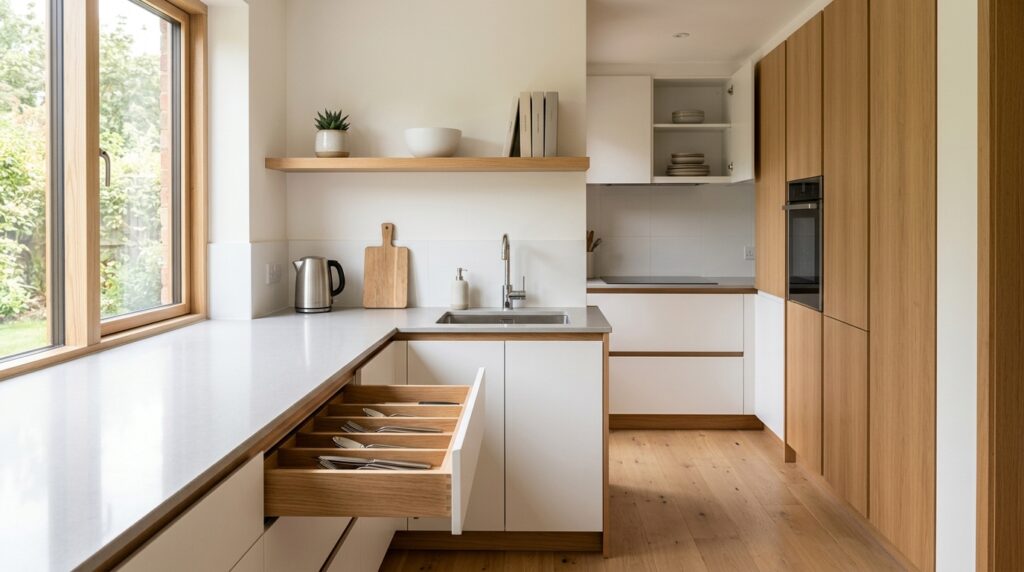
Quick Summary
Good small kitchen storage isn’t just about fitting more in — it’s about doing it in a way that still looks calm and intentional. The trick is limiting duplicates, using vertical space before adding new furniture, and hiding function behind a little bit of style.
Small kitchen storage ideas are everywhere online, but most of them have the same problem: follow enough of them and your kitchen starts looking like a hardware store threw up on your counters. Bins on bins, labels on everything, gadgets hanging from every surface.
I went down that road myself for a while. My kitchen was technically “organized,” but it looked busier than it did before I started. What actually fixed it wasn’t more storage — it was being more selective about what kind of storage I let into the space at all.
This guide is built around that lesson. Every idea here is chosen specifically because it adds function without adding visual noise, so your small kitchen ends up feeling calmer, not more cluttered.
Looking for a broader kitchen refresh beyond just storage? Check out our Small Kitchen Ideas 2026 guide for layout and design tips that work alongside everything here.
At a Glance
- Limit duplicates before buying new storage — most clutter comes from having too many of the same thing
- Vertical space is almost always underused in small kitchens
- Closed storage keeps a small kitchen looking calm, even when it’s fully organized
- Pull-out and roll-out organizers are the top-requested upgrade in 2026 kitchen renovations
- A few open shelves styled intentionally look better than a dozen matching bins everywhere
Table of Contents
1. Start With the One-Shelf Rule Before Buying Anything
2. Use Vertical Space Before You Touch the Counters
3. Create Drawer Zones Instead of One Junk Drawer
4. Choose Pull-Out Organizers Over Static Shelves
5. Hide Function Behind Closed Cabinet Doors
6. Style Open Shelving Like Decor, Not a Warehouse
7. Use the Inside of Cabinet Doors as Bonus Storage
8. Choose Multitasking Tools Over Single-Use Gadgets
9. Mistakes That Make Small Kitchen Storage Look Worse
10. Pro Tips to Implement This Without a Renovation Budget
Comparison Table by Budget
Final Thoughts
Frequently Asked Questions
1. Start With the One-Shelf Rule Before Buying Anything
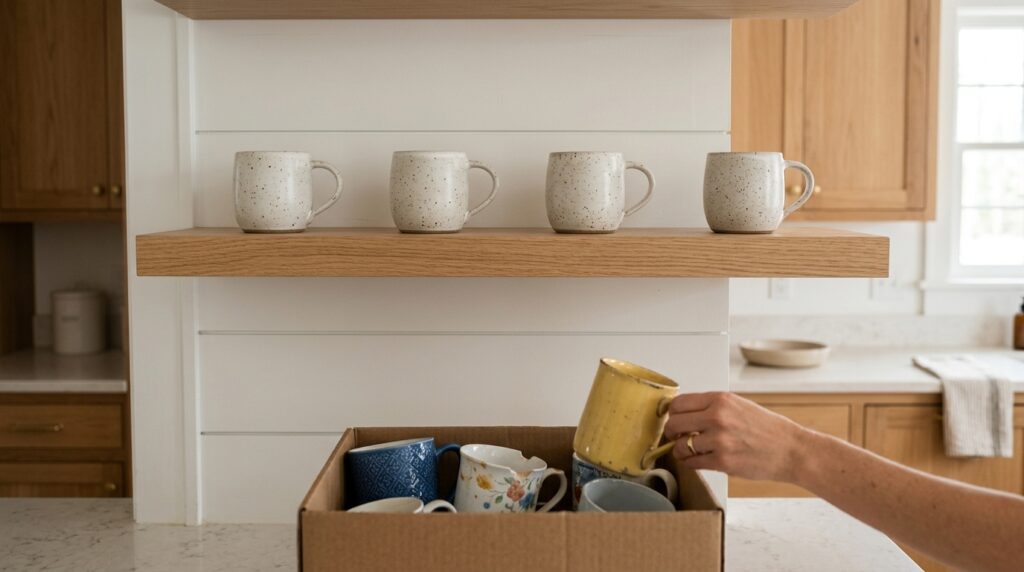
Small kitchen storage ideas usually start with buying something new, but the real fix often starts with subtraction. The one-shelf rule means every category — mugs, containers, tools — gets exactly one shelf or bin, no more.
- Give mugs one shelf, food containers one bin, and utensils one crock or drawer section
- Anything that doesn’t fit in its assigned space gets donated or boxed up, not squeezed in somewhere else
- This works because most small kitchen clutter isn’t a storage problem, it’s a duplicates problem
I counted seven travel mugs in my cabinet once I actually looked. Getting rid of five of them freed up more space than any organizer I’d bought that year.
2. Use Vertical Space Before You Touch the Counters
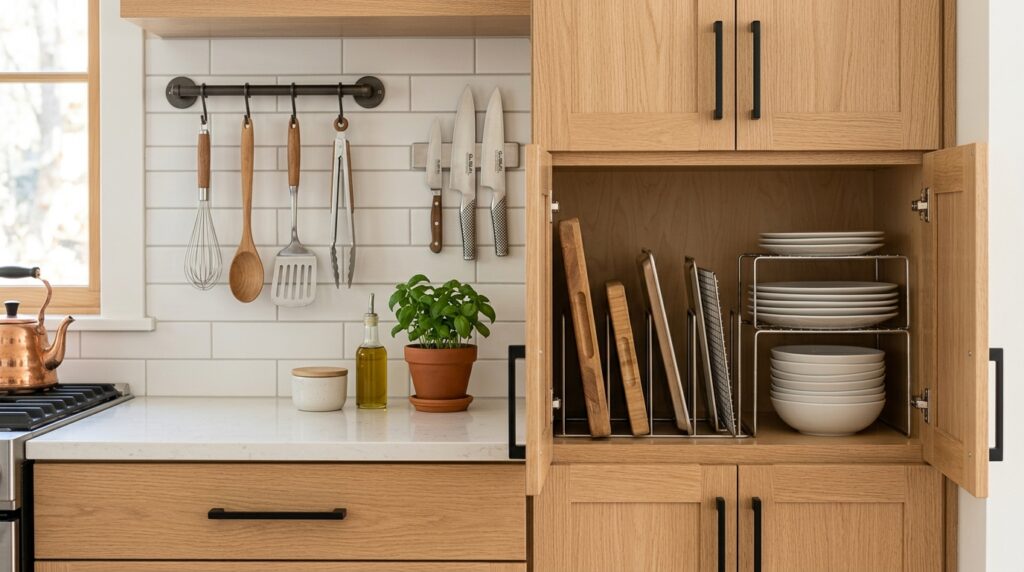
Vertical kitchen storage is the most underused space in almost every small kitchen — the walls above counters and inside cabinets usually sit half-empty while counters get crowded instead.
- Tray dividers let you store baking sheets and cutting boards upright instead of stacked and clattering
- Wall-mounted rails free up drawer space for utensils that would otherwise take up prime real estate
- Stacking risers inside cabinets double your usable shelf space without adding a single new cabinet
Once I started thinking in terms of height instead of just floor space, I realized my kitchen had way more room than I thought — it just wasn’t being used.
3. Create Drawer Zones Instead of One Junk Drawer
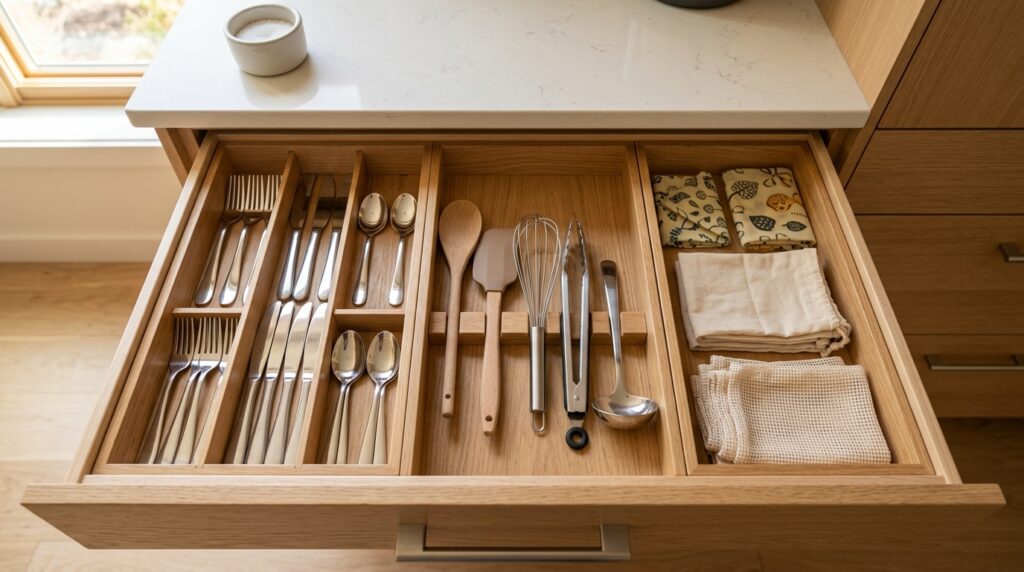
Small kitchen drawer organization works best when every drawer has one job, rather than becoming a catch-all for whatever doesn’t have a home yet.
- Assign each drawer a single task — cooking utensils, cutlery, wraps and bags — rather than mixing categories
- Drawer dividers cost very little but instantly stop items from sliding into a pile every time you open one
- If a drawer becomes a dumping ground again within a week, it usually means the zone needs to be smaller and more specific
My junk drawer used to need a full excavation every few months. Splitting it into three specific zones meant I stopped needing to dig at all.
4. Choose Pull-Out Organizers Over Static Shelves
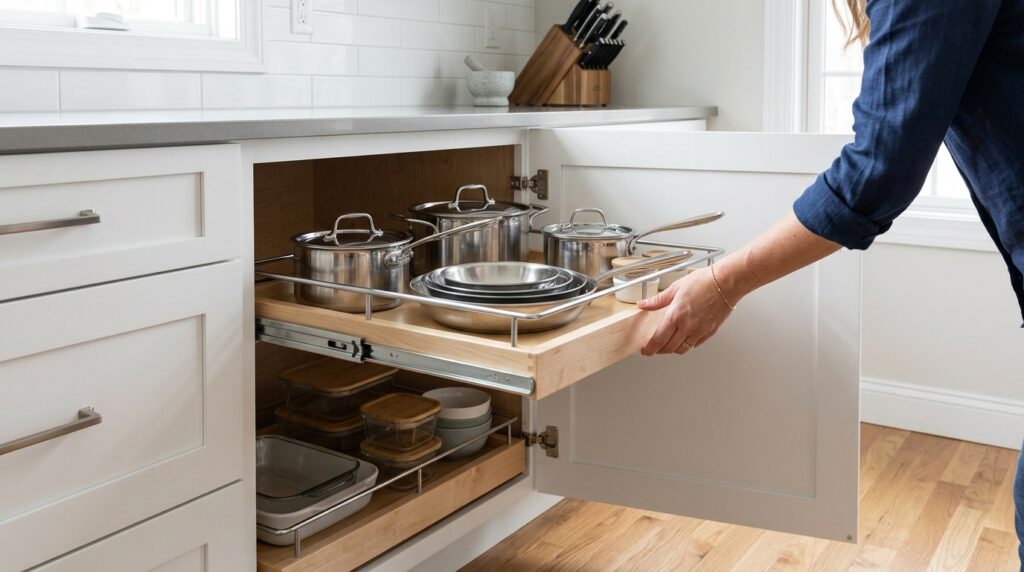
Pull-out kitchen organizers were named one of the most requested storage upgrades in 2026 renovations, and it’s easy to see why once you’ve used one — nothing gets lost in the back of a cabinet anymore.
- Roll-out shelves bring everything into view instead of forcing you to reach blindly into a dark cabinet corner
- They work especially well in lower cabinets, where deep, awkward spaces usually become storage graveyards
- You can find self-install options that don’t require a full cabinet renovation, which matters if you’re renting
According to Shelftheory’s 2026 kitchen storage report, pullouts and roll-out organizers were rated the single most impactful upgrade homeowners made that year — and after installing one myself, I understand why it topped that list.
5. Hide Function Behind Closed Cabinet Doors
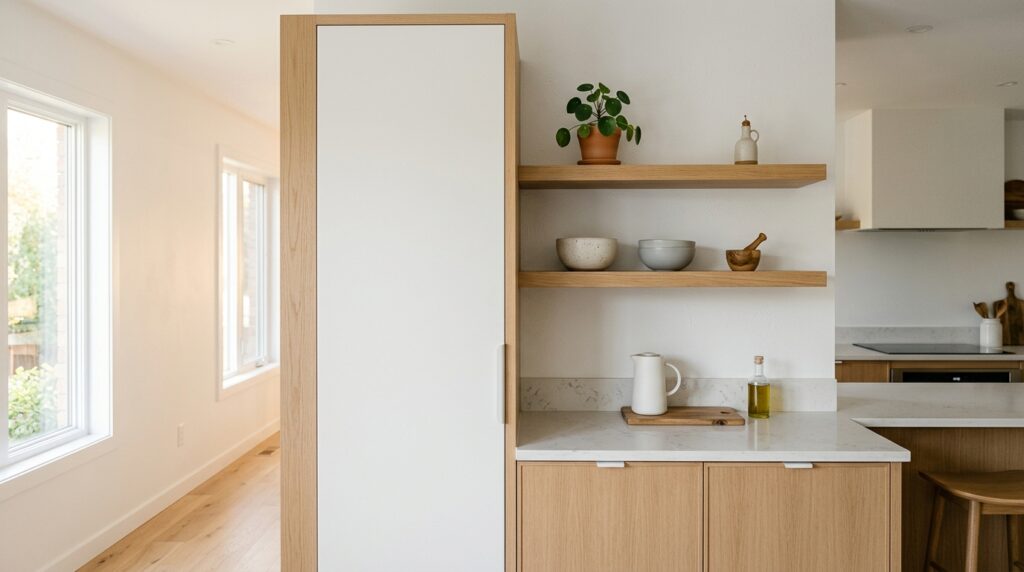
Closed kitchen storage is what actually keeps a small space looking calm, even when every inch of it is being used efficiently behind the scenes.
- A tall, floor-to-ceiling cabinet with a sleek door can hide small appliances and bulk items completely out of sight
- Closed storage doesn’t need to look expensive — even a simple curtain across open shelving does the job
- Reserve open storage for the handful of things you actually want on display, and close off the rest
The single biggest visual change in my kitchen wasn’t adding storage — it was closing off half of what was already open. Less visible stuff meant the whole room instantly felt bigger.
6. Style Open Shelving Like Decor, Not a Warehouse
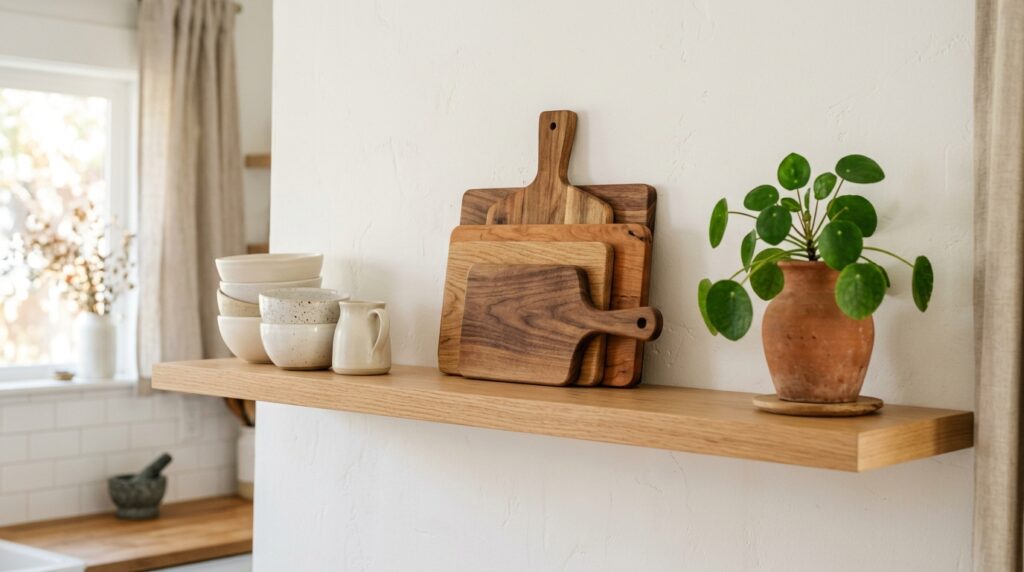
Open shelving in a small kitchen only works if it’s treated like styled decor rather than overflow storage from a cabinet that ran out of room.
- Group items by color or material so the shelf reads as intentional, not random
- Leave visible gaps between groupings — a fully packed shelf reads as clutter no matter how neat it is
- Rotate what’s on display occasionally, the same way you’d rotate decor anywhere else in the house
The difference between an open shelf that looks like a feature and one that looks like a mess usually comes down to how much empty space you’re willing to leave.
7. Use the Inside of Cabinet Doors as Bonus Storage
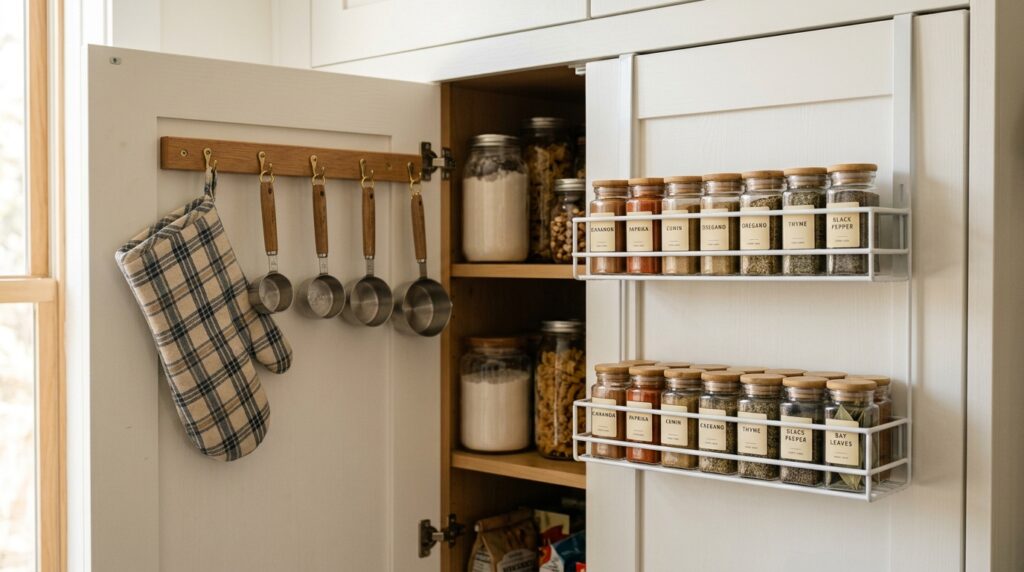
Kitchen door storage is one of the most overlooked spaces in a small kitchen — the inside of every cabinet and pantry door is essentially free real estate that most people never use.
- Self-adhesive hooks on the inside of doors work for anything from oven mitts to small measuring cups
- Thin over-the-door racks can hold spice jars or cleaning supplies without taking up any shelf space at all
- This space is ideal for items you use daily, since it’s fast to grab without digging through a cabinet
I ignored the back of my pantry door for years before adding a simple hook strip. It now holds everything I reach for constantly, and none of it takes up shelf space anymore.
8. Choose Multitasking Tools Over Single-Use Gadgets
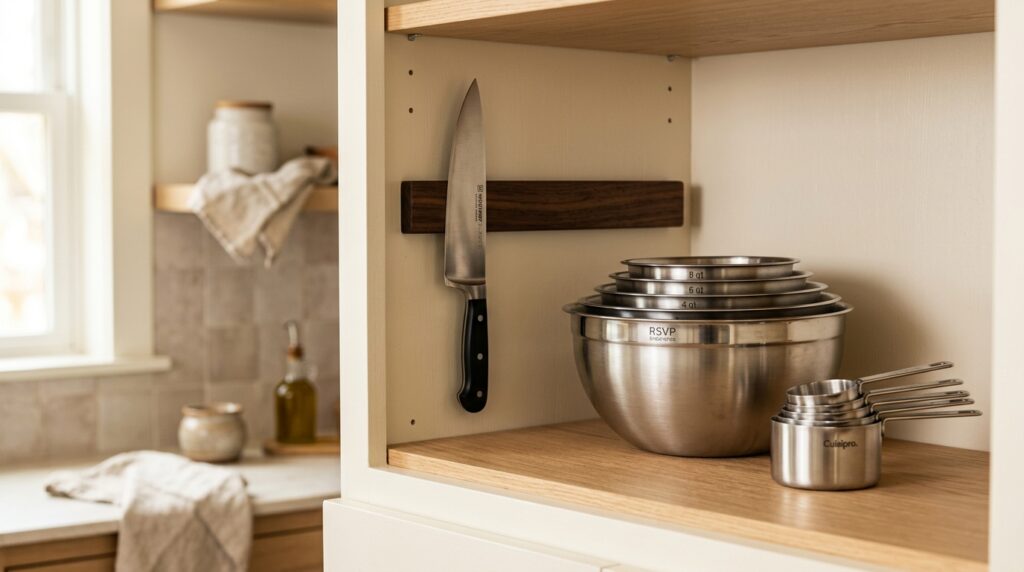
Small kitchen storage gets easier the moment you stop trying to store single-purpose gadgets and start choosing tools that do more than one job.
- A single good chef’s knife replaces half a dozen specialty knives that rarely get used
- Nesting bowls and measuring cups take up a fraction of the space that mismatched sets do
- Before buying a new gadget, ask whether an existing tool could do the same job — it usually can
Every single-use gadget I’ve donated over the years has been one I used maybe twice. The tools that earned permanent cabinet space were always the ones that could do several jobs at once.
9. Mistakes That Make Small Kitchen Storage Look Worse
Most small kitchen storage mistakes come from adding organization systems without first reducing what’s actually being organized.
- Buying storage bins before decluttering, which just organizes clutter instead of removing it
- Mismatched containers and labels everywhere, which reads as busy no matter how tidy the contents are
- Leaving every shelf and surface completely full, with no visual breathing room anywhere in the kitchen
- Hanging too many wall-mounted tools at once, which turns a wall into visual clutter of its own
- Skipping the “one shelf” limit and letting duplicate items creep back in within a few months
Nearly every one of these mistakes comes from treating storage as the fix, when the real fix is almost always reducing what needs to be stored in the first place.
10. Pro Tips to Implement This Without a Renovation Budget
Small kitchen storage tips don’t require a full remodel — most of what’s covered here can be done in a weekend with tools you can install and remove yourself.
- Start with decluttering duplicates before buying a single organizer — it’s free and solves half the problem
- Self-adhesive hooks and stick-on organizers work in rentals without any drilling required
- Tackle one cabinet or drawer at a time instead of the whole kitchen at once — it’s less overwhelming and easier to keep up
- Reassess every few months, since storage needs shift as your routines and habits change
- If you’re unsure where to start, the one-shelf rule from the first section is the single easiest first step
The kitchens that stay organized long-term are almost never the ones with the most storage products — they’re the ones where the system actually matches how the person cooks.
Comparison Table by Budget
Not sure where to start spending? Here’s how these small kitchen storage ideas stack up by cost, so you can prioritize based on your budget.
| Budget | Best Options | Effort |
|---|---|---|
| Free – Under $20 | Decluttering duplicates, drawer zones, door hooks | Low |
| $20 – $60 | Tray dividers, drawer organizers, stacking risers | Low to Medium |
| $60 – $150+ | Pull-out organizers, roll-out shelving systems | Medium |
Final Thoughts
Small kitchen storage ideas work best when they start with less, not more. Before adding a single new organizer, take stock of what you actually use versus what’s just taking up space — that one step alone solves more clutter than any product on this list. Build from there one drawer or shelf at a time, and the calm, organized kitchen follows naturally.
Still not sure where your kitchen’s biggest storage issue is? Feel free to reach out — I’m always happy to help walk through it.
Frequently Asked Questions
What’s the easiest small kitchen storage idea to start with?
The one-shelf rule is the easiest starting point. Limiting each category of item to one designated space forces you to remove duplicates before you even think about buying new storage.
How do I add storage to a small kitchen without renovating?
Self-adhesive hooks, drawer dividers, stacking risers, and over-the-door organizers all add meaningful storage without any construction or drilling, making them ideal for renters.
Why does my organized kitchen still look cluttered?
This usually happens when too many storage products are visible at once, even if they’re neatly arranged. Closing off storage behind cabinet doors and leaving visual breathing room on open shelves solves this.
Are pull-out organizers worth the cost?
For lower cabinets especially, yes. They were rated among the top storage upgrades in 2026 kitchen renovations because they eliminate the “storage graveyard” effect of deep, hard-to-reach cabinet corners.
Should I use open shelving in a small kitchen?
Open shelving can work well if it’s styled intentionally with a few curated items and visible gaps. If it becomes overflow storage from a full cabinet, it will make the kitchen look more cluttered instead of less.
Pingback: Halloween Kitchen Decor: 31 Bewitching Ideas You'll Love